
UN, universities highlight entrepreneurship in Jinju
- 작성일2025년10월28일 11시42분
- 조회수364
UN, universities highlight entrepreneurship in Jinju
By Ko Dong-hwan
- Published KST
- Updated KST
Human centricity over AI innovation a key value
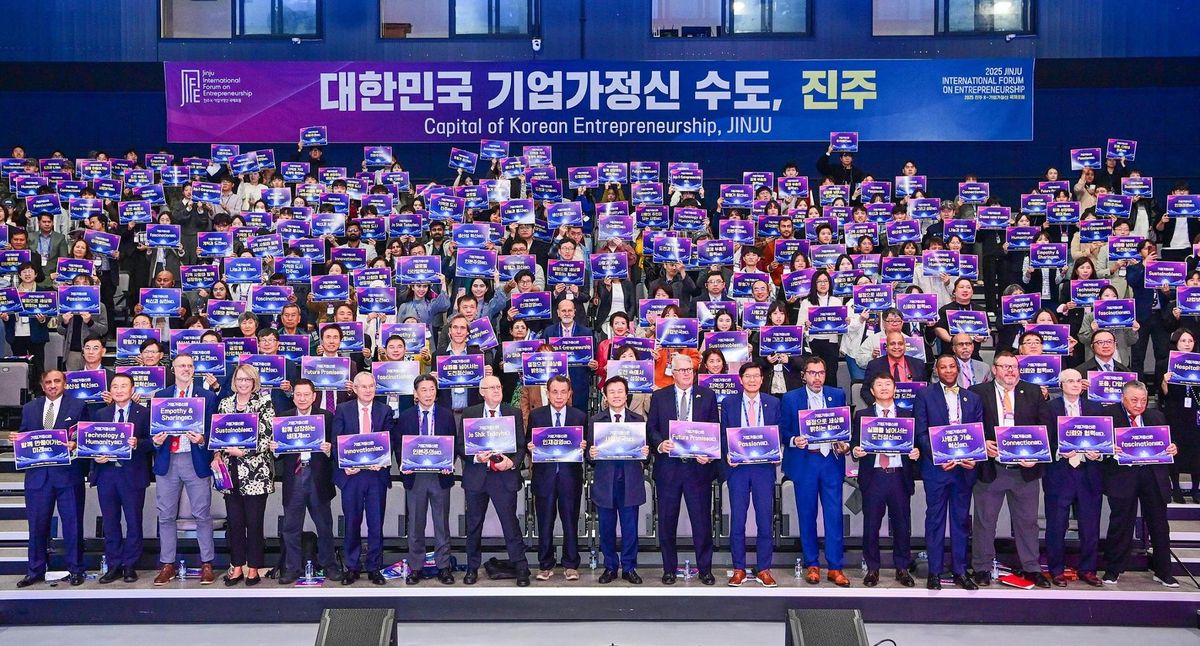
Participants of the 2025 Jinju International Forum on Entrepreneurship hold posters proclaiming Jinju as the “Capital of Korean Entrepreneurship” at Centennial Memorial Hall on the campus of Gyeongsang National University in Jinju, South Gyeongsang Province, Monday. Courtesy of Jinju City
JINJU, South Gyeongsang Province — The United Nations and universities worldwide on Monday highlighted the roles of entrepreneurship amid fast-changing technological trends that seemingly overwhelm global communities, recalling past corporate leaders who valued the idea of putting people first and the significance of sustainable goals and higher education.
Day 1 of the 2025 Jinju International Forum on Entrepreneurship focused on the topic of pioneering spirits and the required role of entrepreneurs in tackling global issues including climate change, cutting-edge technologies, the rise of populism and various global trade hurdles, such as the spread of protectionism and unstable global supply chains.
Amid such challenges, Korean entrepreneurship drew attention from participants of the event, as the past 70 years saw business leaders here rebuild the nation from the ruins of the 1950-53 Korean War to become a global economy. Jinju, a southern city in South Gyeongsang Province and the birthplace of business moguls who founded global Korean conglomerates like LG, Samsung, GS and Hyosung, held additional historic significance for foreign participants.

Kim Jong-wook, president of the Jinju K-Entrepreneurship Foundation, delivers opening remarks at the 2025 Jinju International Forum on Entrepreneurship, at Centennial Memorial Hall on the campus of Gyeongsang National University in Jinju, South Gyeongsang Province, Monday. Courtesy of Jinju City
U.N. representatives interpreted entrepreneurship as wise leadership that adapts to different eras and demands. While artificial intelligence (AI)-based technology is sweeping global industries and societies, they emphasized the significance of sustainable goals and leadership to counterbalance AI's impact.
Csaba Korosi, who served as the 77th president of the U.N. General Assembly, highlighted the importance of the U.N.’s sustainable development goals (SDGs) in connection with global industries and entrepreneurship.
“When we produced the SDGs, we calculated that achieving this sustainability transformation will be the largest kind of transformation in the history of mankind. It would require the reorientation of investments in the range of $92-95 trillion within 15 years. And that transformation will work only if it works in the real economy,” Korosi said during the first session of the forum.
He added, “There is currently no agreed methodology of measuring sustainability transformation through integrated impact. My plea to all those involved in developing AI — please make sure that AI agents come to the help of sustainability transformation.”

Jinju Mayor Jo Kyoo-il, left, poses with Winslow Sargeant, chief counsel for advocacy at the U.S. Small Business Administration, after presenting him with honorary citizenship of the city at Centennial Memorial Hall on the campus of Gyeongsang National University in Jinju, South Gyeongsang Province, Monday. Courtesy of Jinju City
Jehangir Khan, secretary-general of the Council of Presidents of the U.N. General Assembly, who has served for 43 years in the U.N., said the practice of entrepreneurship leadership today is in scarce supply in political, economic and social spheres.
“Good entrepreneurship is the most precious resource of any society, of any institution, of any organization. I often say that a nation or an enterprise can be blessed with many resources, but if it has poor leadership, it will never succeed,” Khan said.
He added that entrepreneurs must now mobilize in the face of the AI revolution, so that new technology does not become a disruptive force or constraint but serves humanity.
“AI is evolving at such a pace that it actually challenges our own human ingenuity. Corruption and bad leaders now also grow like cancer, stifling entrepreneurship. Fundamentals like U.N. SDGs must be preserved,” he said.

Ayman El Tarabishy, president and CEO of the International Council for Small Business, speaks during the first session of the 2025 Jinju International Forum on Entrepreneurship at Centennial Memorial Hall on the campus of Gyeongsang National University in Jinju, South Gyeongsang Province, Monday. Courtesy of Jinju City
Educators from the United States, Malaysia and Korea took the stage in the second session, showcasing how their universities are training students to become future entrepreneurs amid these global challenges. Their curricula all strive to adapt classrooms to real-life industries so that the institutes can serve as engines of sustainable, inclusive and entrepreneurial ecosystems.
Stuart Rayfield, president of Columbus State University in the U.S. state of Georgia, said her school has been serving local issues by training students with skills required to solve those issues. Founded in 1958, the school was established at the will of the local community “to serve our region, our state and our nation.”
“We partner with local industries to ensure that our education is in alignment with what those institutions and those organizations need. In the late 1990s in Columbus, there was a rising fintech company providing a financial payment processor service. When it was on the verge of leaving the city due to a lack of computer programmers in the city, we partnered with the company to develop a curriculum that even today still supports the computer coding that they need,” Rayfield said.
She added, “This year, we launched a new program for first-year students, which is a data analytics class. The students partner with the Columbus Fire Department, gaining access to the department’s data. At the end of the semester, the students develop skills of communication, problem-solving, taking the initiative and asking really good questions. Smart entrepreneurs have to adapt.”
UN, universities highlight entrepreneurship in Jinju - The Korea Times